Safety & Risks
How to Clean a Glass Cooktop Without Scratching It — Including the Controls
To clean a glass cooktop without scratching it, let it cool, lift burnt residue with a razor scraper held at a shallow angle against the glass, then finish with a purpose-made ceramic cooktop cream and a soft cloth. The scraper is the correct tool and is safe when kept shallow; abrasive pads, scouring cream and dried-on grit dragged under a cloth are what actually dull the surface. Never clean the sensor control area with a wet cloth while the top is on — it reads as a key held down and locks the controls out.
The full guide
How to clean a glass cooktop without scratching it, and what actually causes scratches
Most people have this backwards. The tool everybody is afraid of is the safe one, and the cloth everybody reaches for is doing the damage.
Scratches on ceramic glass almost never come from a scraper. They come from grit — a grain of burnt food, a speck of sand off a pan base — being dragged across the surface under a cloth or a sponge. And they come from abrasive pads, which do it evenly and slowly enough that nobody connects the haze to the habit.
So the order below starts by getting the grit off before anything touches the glass.
The five steps
Let it cool completely. Cleaning product on a hot surface bakes on and can mark it. There is exactly one exception, below.
Lift the loose material off first, with a dry paper towel or a soft brush. Do not wipe — lift. This is the step that prevents scratching and it is the one everybody skips.
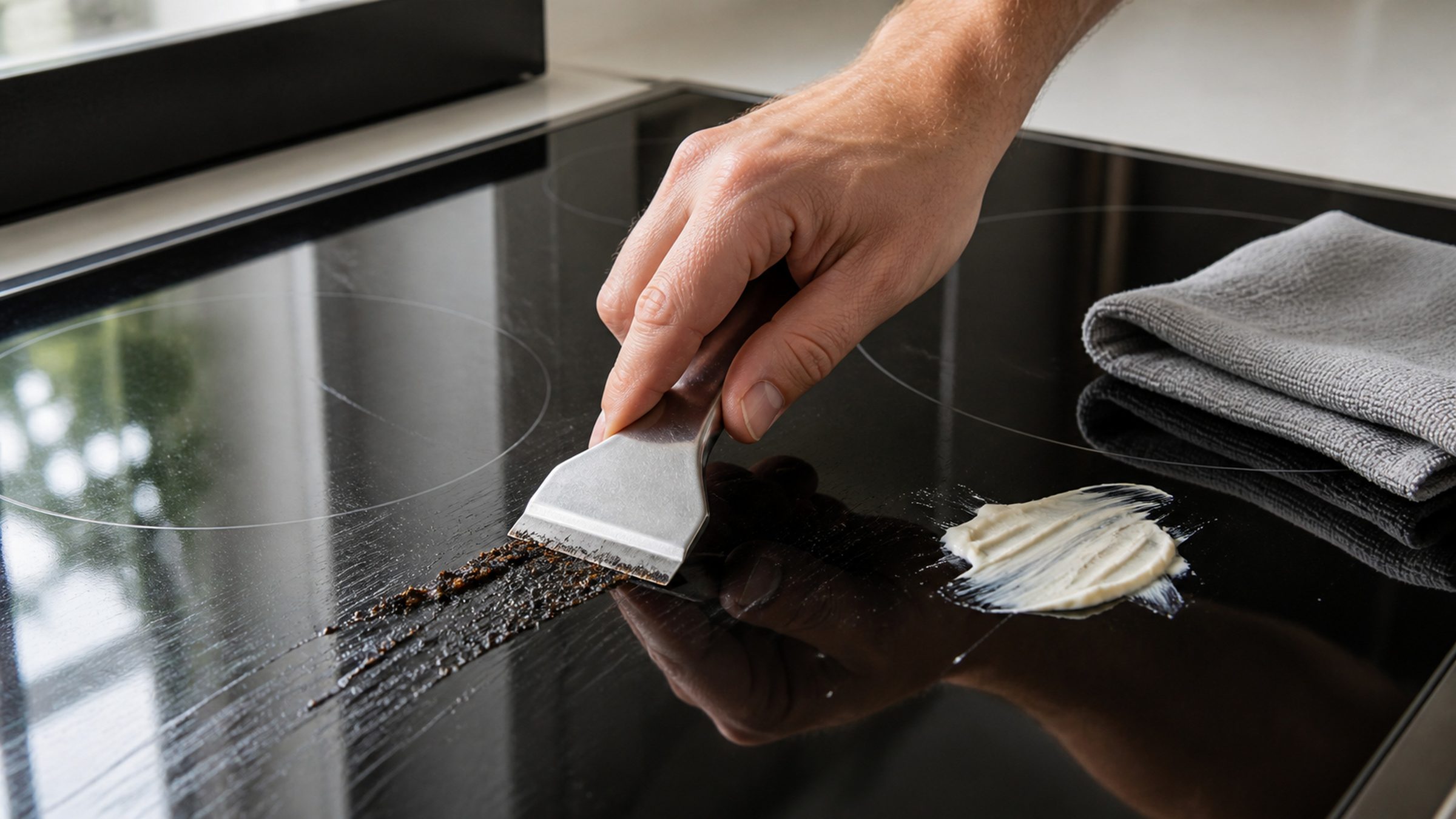
Scrape the burnt-on residue with a razor scraper held almost flat against the glass, around ten to fifteen degrees. Let the blade slide underneath and lift. This is the tool the manufacturers themselves recommend, and it is safe at a shallow angle. Steep is what chips.
Finish with a ceramic cooktop cream. A few drops, spread with a soft cloth or paper towel over the whole surface, then buffed off with a clean dry cloth. The cream contains a very fine polish and a protectant, and it is what keeps the surface looking new rather than merely clean.
Clean the control area separately, with the appliance off.
The sugar exception
The one time you do not wait for it to cool.
Melted sugar, jam, or anything sugary must come off while the surface is still hot. As it cools it bonds to the glass and taking it off afterwards frequently takes a flake of the surface with it — a permanent, visible pit.
Oven mitt, scraper, straight away, and accept that it is unpleasant. It is a great deal less unpleasant than the alternative.
The part that is specific to this make
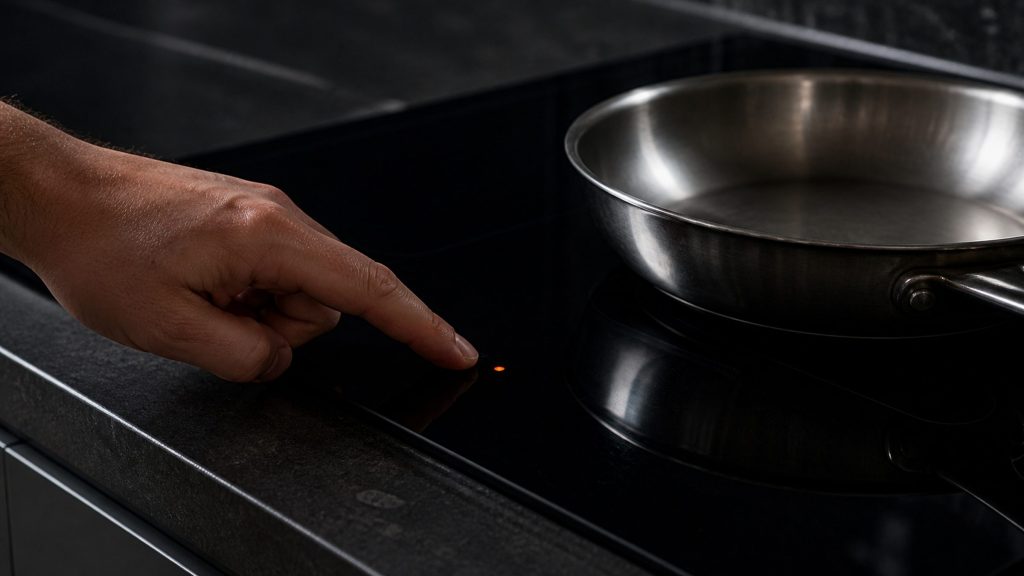
Miele's induction and radiant tops use sensor controls, and a wet cloth on the control area is indistinguishable from a finger held down.
The appliance responds the way it is designed to: it stops accepting input and locks itself out rather than doing something unintended with a pan on. People then conclude the cooktop has broken during cleaning.
Clean the controls with the top switched off and a cloth that is barely damp, and dry the area fully before switching back on. If it is already locked out, clear everything off, dry it, and if it still will not respond, switch off at the breaker for five minutes.
The manufacturer treats "the sensor controls are no longer responding" as a real published condition — it is common enough to be documented — and the free version of it is exactly this.
What never to use
- Abrasive pads, nylon or steel. They dull the surface progressively.
- Melamine sponges. Fine abrasives, same result.
- Scouring cream intended for sinks. Wrong particle size entirely.
- Oven cleaner. Aggressive toward the printed control markings, and once those are gone they do not come back.
- A cloth that has been used on anything gritty. The commonest cause of a scratch in a well-kept kitchen.
Two habits that keep it looking new
Wipe spills as they cool, every time. Ninety percent of the difficulty of this job is residue that has been cooked twice.
Check pan bases. A cast iron base with casting sand on it, or a stainless base with a burr, will mark a ceramic top on the first use. Run a finger round the rim of the pans you use most; anything sharp is worth taking down with fine emery.
The thing that is not a cleaning problem
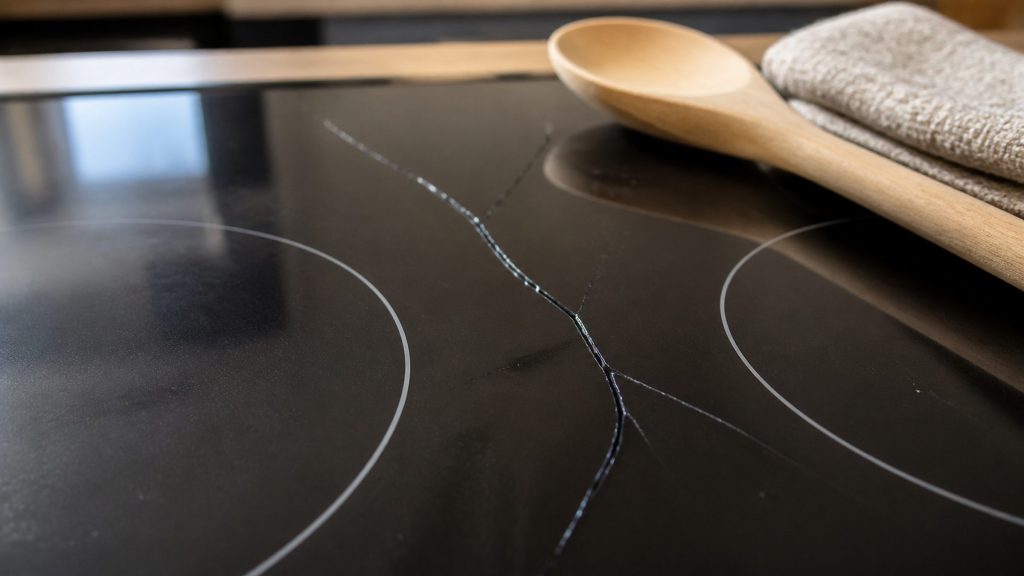
A crack, particularly one reaching the edge. On an induction or radiant top the glass is the barrier between spills and the electronics underneath, and a crack lets liquid straight through.
That one is switch it off at the breaker and stop using it, rather than clean it more carefully.
A five-minute weekly routine that removes the need for the rest
Nothing on this page is difficult. All of it becomes unnecessary if the surface never gets to the state where it needs a scraper.
After cooking, once the top has cooled, a damp cloth and a dry one. Thirty seconds. That is it.
Once a week, the cooktop cream. Two minutes, and it is what keeps the finish even rather than gradually hazing in the places you cook most.
Once a month, look at the pan bases. This is the one nobody does and it is where the marks come from: a burr on a stainless base, casting sand still on the underside of new cast iron, a copper base that has picked up grit. Run a finger round the rim of each pan you use regularly.
What a well-kept ceramic top should look like at five years
Even, with no cloudy patch where the biggest burner is. That cloudy patch — and it is very common — is not wear. It is an abrasive cleaning habit applied to one area more than the rest, and it is the single clearest sign that a green pad has been in use.
If you have one already, the cream will improve it and will not remove it. Prevention is the whole of this page.
Independent Miele service across Miami-Dade, Broward and Palm Beach. We are not affiliated with, authorized by or endorsed by any manufacturer.
If it turns out to be a repair
What this leads to, and what it costs
Every job on this site is priced the same way: an on-site diagnostic first, the figure agreed in writing before anybody starts.
-
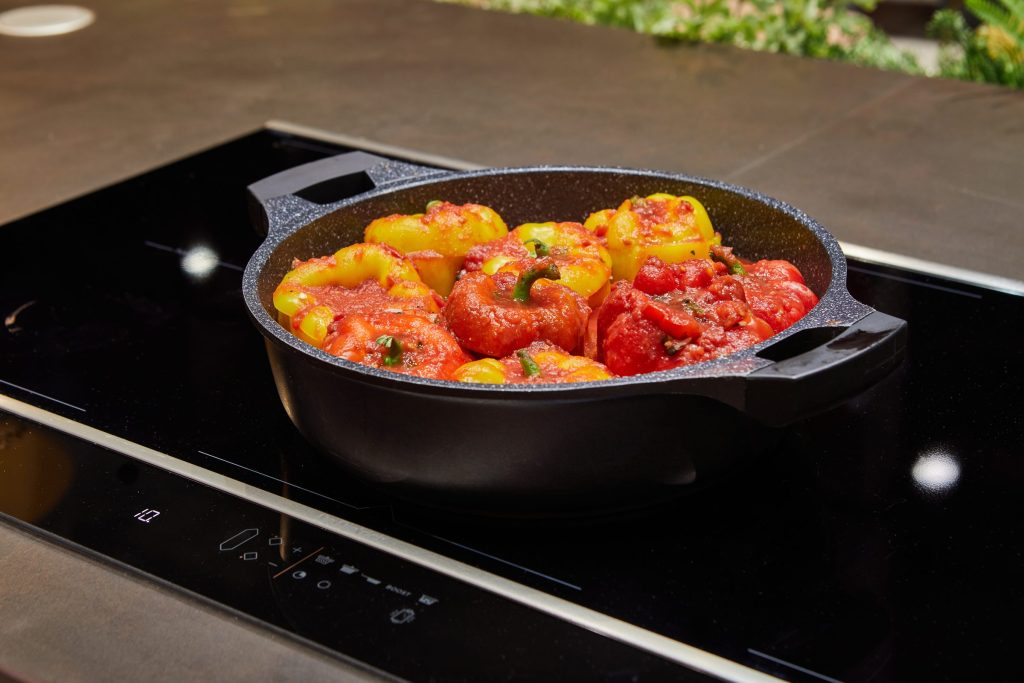
KM induction · KM gas · KM electric · KMR rangetops · 24" to 48" Cooktops and rangetops
The one place this make writes something other than F and a number: the induction tops write FE, and a bare F with nothing after it is its own condition. Induction also reports more than any other cooking surface Miele builds — and most of what it reports is about heat and about the glass rather than about a part.
- A zone that switches itself off part-way through cooking
- Controls that stop responding to touch
- A gas burner that lights and drops out
-
The touch panel has stopped answering Cooktop controls will not respond
A sensor control reads a wet patch or a pan lid as a finger held down, and locks out. That is the free version. The other version is the touch board, and telling them apart takes five minutes.
- No response to touch at all
- A lock symbol that will not clear
- It works again once the top is cold
-
Stop using it Cooktop glass is cracked
On an induction or radiant top the glass is the barrier between spills and the electronics underneath. A crack that reaches the edge lets liquid straight in, and this is the one thing on this site we ask people to stop using immediately.
- A crack running to the edge
- A chip at the frame
- Crazing around one zone

Questions people ask about this
A razor blade, really?
Really, and it is what the manufacturers recommend. Held almost flat, the blade slides under residue and lifts it off the glass. Held at a steep angle it can chip, which is why the technique matters more than the tool — but a scraper used properly is far gentler than a scouring pad used carefully.
What about sugar spills?
Those are the exception to the cool-down rule. Melted sugar or anything with sugar in it should be scraped off while the surface is still warm, because when it cools it takes a piece of the glass with it. Wear an oven mitt and use the scraper immediately.
Can I use a magic eraser or a green pad?
No to both. Melamine sponges and nylon scouring pads are abrasive on a scale that dulls ceramic glass over months rather than instantly, which is exactly why nobody attributes the haze to them.
Why did my controls stop working after cleaning?
Because a wet cloth on the sensor area is indistinguishable from a finger to the appliance. Clear everything off, dry the surface completely, and if it still will not respond, switch it off at the breaker for five minutes.
Will a scratch affect how it works?
A light scratch is cosmetic. A crack is not, and the two are worth telling apart carefully — anything that reaches the edge of the glass lets liquid to the electronics, and that is a stop-using-it situation rather than a cleaning one.
Safety & Risks
More guides like this one
-
How to Clean Mold from a Refrigerator Door Gasket — and Why It Came Back
Cleaning it is twenty minutes. It returning within a month means the seal is no longer closing along that section — which is a repair, not a cleaning schedule.
Read more -
Hurricane Season: How Long Food Will Last in Fridge and Freezer After an Outage
Four hours closed is the federal guidance and it assumes nobody opens the door — which is the part that fails. A heavy built-in holds longer, and the appliance may have kept a record.
Read more -
How Long Does Miele Oven Self Cleaning Take, and the Step Before It
The duration is the easy half. The important half is that the maker publishes a condition for the clean temperature not being reached because of soiling left in the cavity.
Read more
Tell us the model number and what it is doing.
This article is based on:
- Official manufacturer documentation
- Internal repair procedures
- Technician repair history
- Company quality standards