Common Problems
Why Does My Miele Dryer Take So Long to Dry? Design, or a Problem
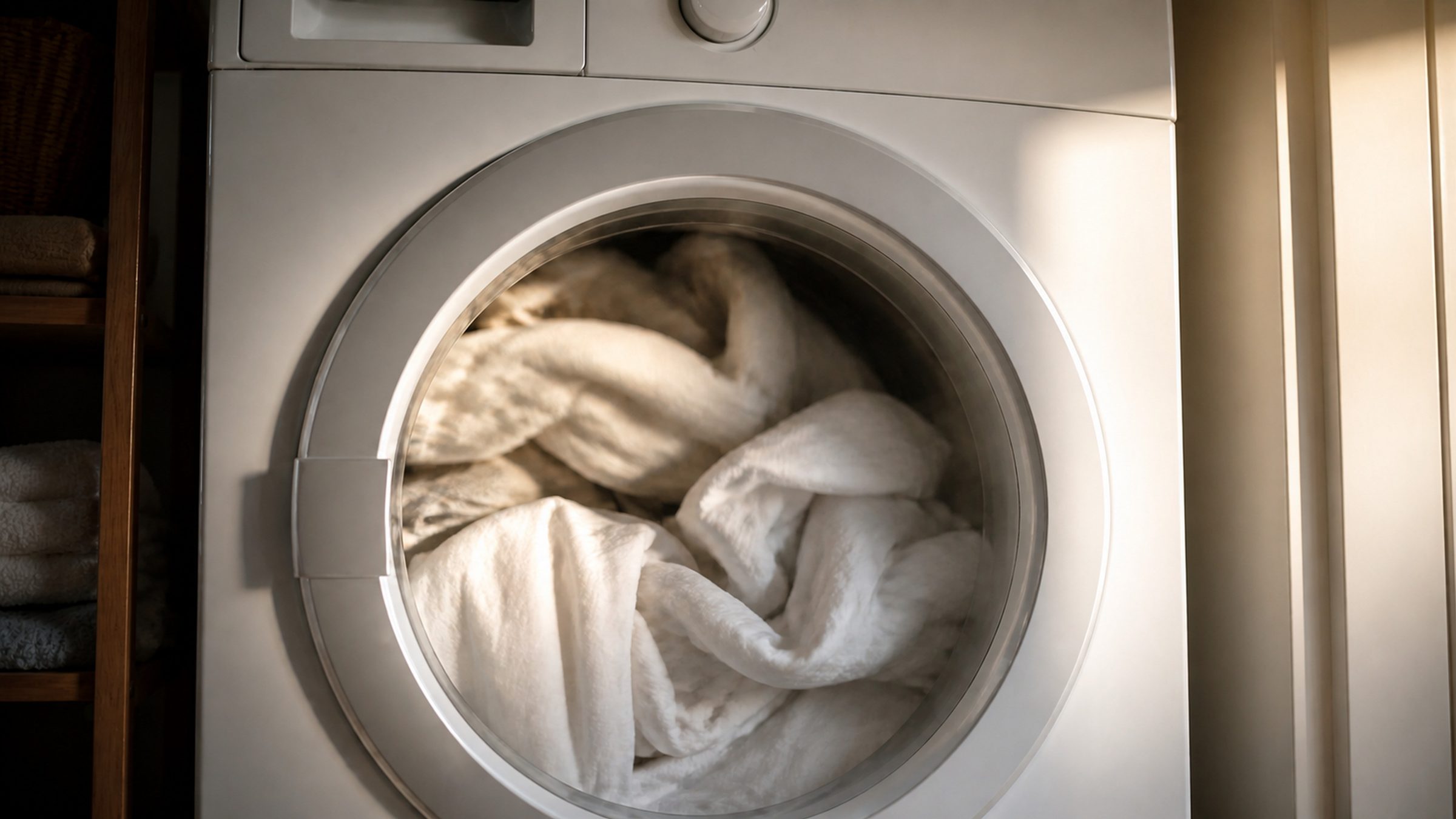
A Miele dryer takes so long because it is a ventless heat-pump machine: it runs at a much lower temperature than a vented dryer, which is what makes it gentle on fabric and efficient. Two to three hours on a full cotton load is normal. What is not normal is a cycle that has got noticeably longer than it used to be — that is nearly always the two filters, the condenser block, or the room the machine takes its air from.
The full guide
Why does my Miele dryer take so long to dry, and what should the number be?
Because it is a heat pump, and a heat pump dries at a temperature a vented dryer never sees.
A conventional dryer heats air hard, drives it through the clothes and throws it out of the house. It is quick, it is hard on fabric, and it exports the conditioned air you paid to cool along with the moisture. A heat-pump machine runs the air in a loop at a much lower temperature, condensing the water out and putting the heat back in.
Lower temperature means longer cycles. Two to three hours on a full cotton load is normal. That is not a machine underperforming; it is the whole reason the clothes last and the energy bill is a fraction of the vented equivalent.
So the useful question is never "is this slow." It is "is this slower than it was."
The signal that matters: the trend
If your machine did a load in two hours when it was new and takes three and a half now, that is real information and it has almost certainly not developed a defect. It has developed a restriction.
Three causes, in order of likelihood.
Cause one: the filters — both of them
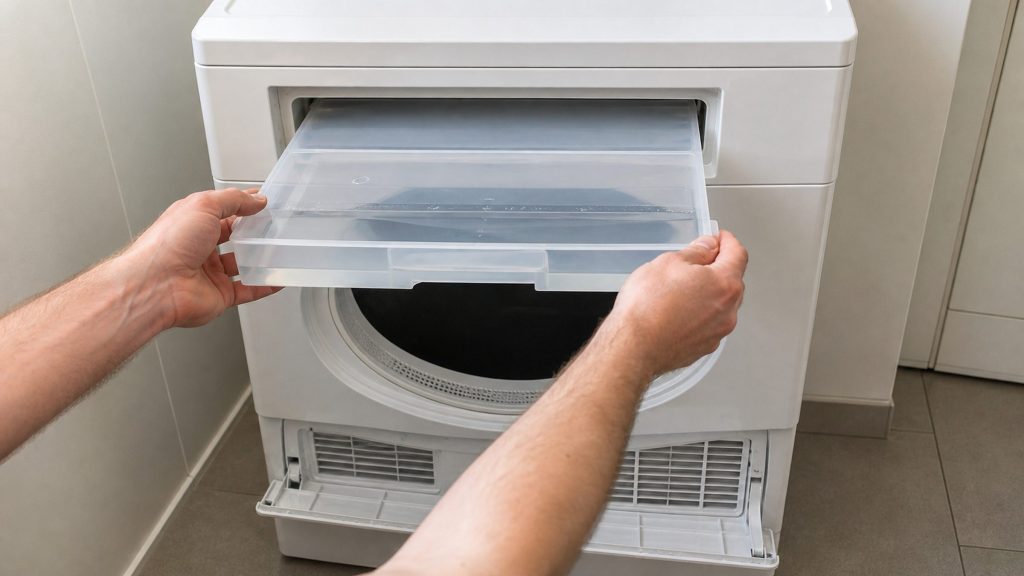
There are two. The one in the door opening catches coarse lint and most people clean it. The plinth filter behind the panel at the bottom front is finer, protects the condenser, and on the machines we open here has very often never been touched.
Hold the plinth filter up to a window. A loaded one looks unremarkable flat and is completely opaque against the light. That mat is what the machine has been pushing air through.
Miele publishes a condition naming these filters as a cause in its own documentation, which is the manufacturer's way of saying this is what happens.
Cause two: the condenser block
Directly behind that filter. The fins should be clean metal. Felted with damp lint — and in this humidity the lint is damp — they restrict the airflow the whole refrigerant loop depends on.
A soft brush or a vacuum with a brush head lifts the loose material. A hard nozzle bends the fins, which is a permanent restriction, so it is worth being gentle or having it done.
Cause three: the room, and this one is local
A ventless dryer takes its air from the room it stands in. In a closed laundry closet in Miami in August, that air is warm and close to saturated before the machine touches it, and the machine has to shed its heat into the same small space.
The free test: run one normal load with the closet or laundry room door open, and compare the time against the same kind of load with it closed. A meaningful difference means the answer is ventilation rather than a repair — a louvered door, a gap top and bottom, or a grille into the room.
We see this constantly, and it is the single most satisfying diagnosis on this appliance because it costs nothing.
Two things people blame that are rarely it
The moisture sensors. They can be coated with softener residue and read late, which does extend a cycle — but they are further down the list than the air path, and cleaning them without cleaning the filters first is doing the second job before the first.
The heat pump itself. The compressor and the sealed circuit are the expensive answer and the least likely one. A machine whose circuit is genuinely failing usually never gets warm at all rather than getting slowly slower, and that is a different complaint.
The load, which is not the machine at all
Worth one paragraph because it changes cycle times more than anything else on this page.
Spin the wash faster. A load coming out of the washer at 1,600 rpm has substantially less water in it than one at 1,000, and every drop the dryer does not have to remove is time it does not have to run.
Do not overfill. Clothes have to tumble to present a surface. A drum packed to the top slides in a lump, and the machine dries the outside of the lump for three hours.
Separate heavy from light. A towel and a shirt in the same load means the machine runs until the towel is dry.
The order to work through
Door filter, plinth filter, condenser fins, room ventilation, then load habits. Everything on that list is free. If the cycle is still growing after all five, it is worth a look — and the number on the display, if there is one, is what to bring to the call.
What a normal cycle actually looks like, in numbers
Worth having a reference, because most of the anxiety here comes from comparing against a vented dryer.
A full cotton load, spun at 1,400 rpm, in a room with reasonable air: two to two and a half hours. The same load spun at 1,000 rpm: add half an hour, because the machine is removing water the washer left behind. Synthetics and shirts: often under an hour and a half. Towels, packed to the top of the drum: three hours and upward, and much of that is the packing rather than the towels.
Against that, the number that means something is your own machine a year ago. Write down today's time for a load you run often. That single note turns every future version of this question into a measurement instead of an impression.
Independent Miele service across Miami-Dade, Broward and Palm Beach. We are not affiliated with, authorized by or endorsed by any manufacturer.
If it turns out to be a repair
What this leads to, and what it costs
Every job on this site is priced the same way: an on-site diagnostic first, the figure agreed in writing before anybody starts.
-
T1 heat pump · Ventless · 24" · 120V · No duct required Heat-pump dryers
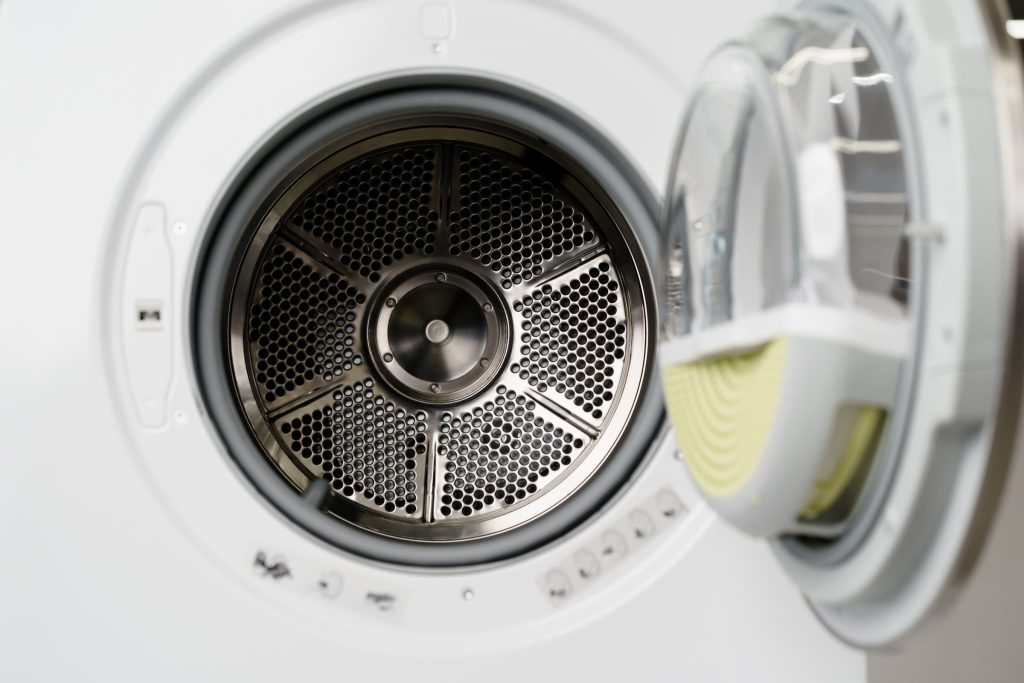
Every dryer Miele sells in the United States is a heat pump, and there is no vented model to compare it to. That is the single most useful thing to know before booking: this machine has a sealed refrigerant circuit rather than a heating element, so almost nothing that goes wrong with it is what goes wrong with an ordinary dryer.
- Clothes coming out damp after a full cycle
- A cycle that stops and shows a number
- A machine that runs and never gets warm
-
It finishes, eventually Dryer cycles are getting longer
A heat-pump dryer is slower than a vented one by design, and that is not a problem. A cycle that is getting steadily longer than it used to be is — and it is nearly always the air path.
- Cycles noticeably longer than a year ago
- The machine warm to the touch on the outside
- Clothes dry but only just
-
from $135 Dryer condensate & filter service
Priced as maintenance on purpose, because on a ventless dryer in this humidity it is the row that keeps the expensive one away. Filters, condenser block, condensate path and the sensors that all three affect.
- Both filters and the condenser block cleaned properly
- Condensate container, float and pump checked
- Drum sensors cleaned so the cycle ends when it should
Questions people ask about this
My old vented dryer did a load in 45 minutes.
It did, at a much higher temperature, by heating air and throwing it and your conditioned air outside. The trade is real: this machine is slower, considerably cheaper to run, and far gentler on fabric. It is a different appliance rather than a worse version of the same one.
Does an overloaded drum make it slower?
Substantially. Clothes have to tumble to present a surface to the air, and a packed drum slides rather than tumbles. Two thirds full is the useful maximum, and it is often faster to run two sensible loads than one heroic one.
Is it slower in summer?
In South Florida, yes, measurably. The machine takes its air from the room and room air in August is already close to saturated. It is not a defect and it is one of the few appliance complaints here with a genuine seasonal pattern.
The cycle timer keeps going up while it runs.
That is the machine re-estimating rather than misbehaving. It measures the moisture in the load and revises, which is why a heavy or unusually wet load can show a rising time. A cycle that consistently overruns its estimate is a different matter.
Would plumbing the condensate to a drain speed it up?
No — that changes where the water goes, not how fast it is removed. It is worth doing for convenience, not for speed.
Common Problems
More guides like this one
-
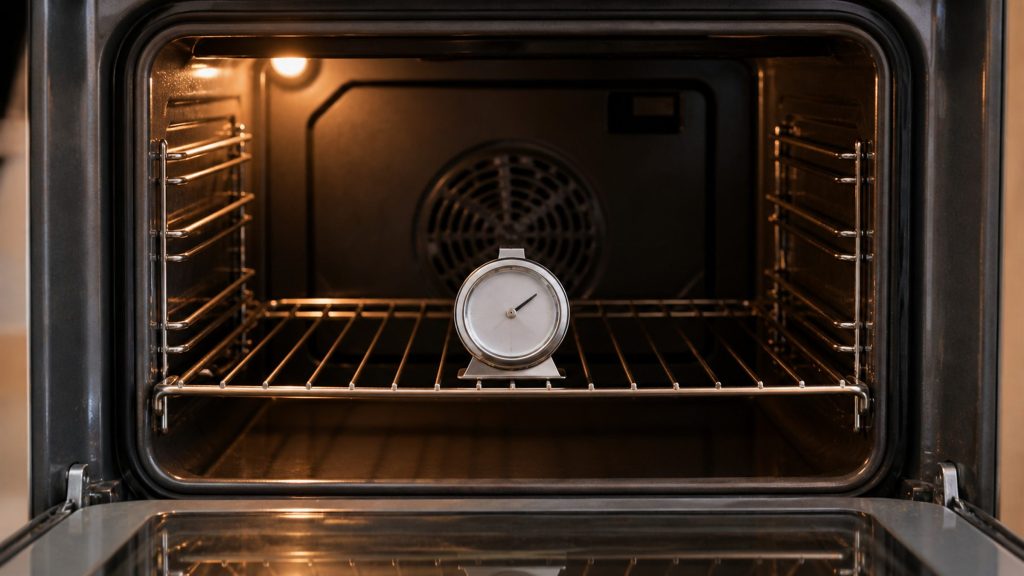
Why Does My Miele Oven Take So Long to Preheat? Cavity Size, or a Sensor
An oven that says it is ready is making a claim you can check with a $10 thermometer. That check separates characteristic from failing in twenty minutes.
Read more -
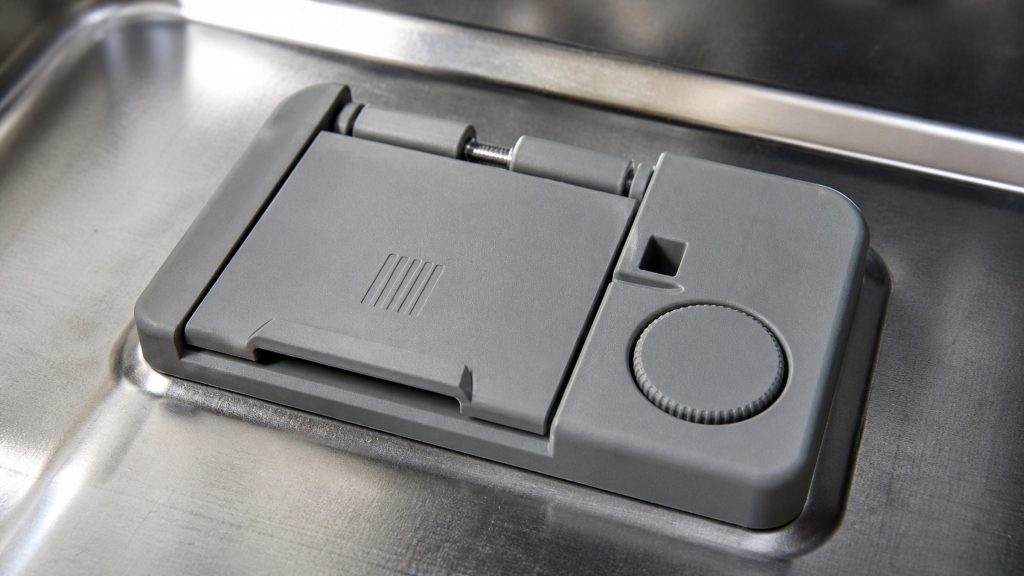
Why a Miele Dishwasher Gets Through So Much Rinse Aid
Usually the dosage setting nobody has ever opened — and occasionally a dispenser that is leaking its contents into the tub every cycle.
Read more -
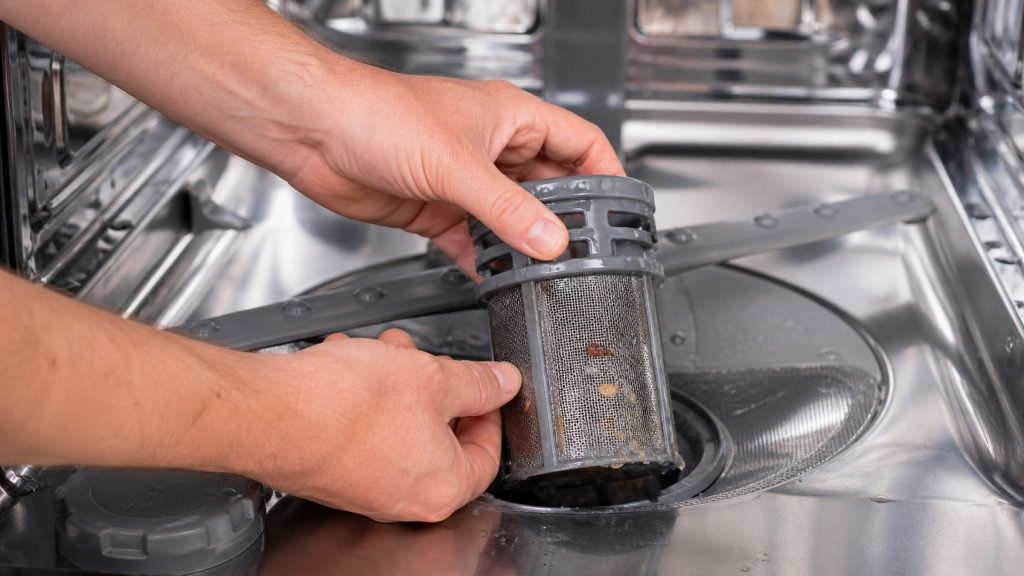
When a Miele Dishwasher Smells Bad: Four Smells, Four Causes
Rotten eggs, wet dog, fish and burning are four different problems, and only the last one is urgent. Which one you have decides everything.
Read more
Tell us the model number and what it is doing.
This article is based on:
- Official manufacturer documentation
- Internal repair procedures
- Technician repair history
- Company quality standards